History has known the people who have spent their lives behind ideas that have become realities of today and it has taken years to bring those thoughts to shape. It was their initiative, but the world seldom remembers those who have influenced the lives of others by thinking differently.
Years of dedication and thinking have brought to life an idea that I had envisioned and though poeple are happy with it I have rarely felt that joy. Any how I do feel very lucky and grateful to my Maula (TUS) whose duas have materialized my virtual dreams into reality and there is much more to do. I feel his eyes looking at me as I write this log. May Allah bless our beloved Maula (TUS) with the pink of health.
Monday, February 22, 2010
Friday, January 01, 2010
Raigarh Ashara 1431
It was almost 3 hours before the Pehli Raat that I got the Taqleed Mubarak and it was very far off. RAIGARH in Chhattisgarh is 2 hours by train from Bilaspur. The nearest International Airport is Nagpur. Immediately after booking the ticket which had a 60+ waiting list I lost hope for a confirm ticket but I had to make it and travel was of 26 hours from Mumbai. I did manage to get through to RAC and the journey was quite easy. 15 families and a total of 72 Mumineen including children it was a very small place in terms of a moze but I had to do what I had to. A lot of things did need a close look and I think it must have been my fate to be there to resolve certain issues and matters.
Looking back at the last day of my visit I feel satisfied of the number of things that were accomplished in such a sort trip. Issues of Madrasa, afternoon niyaz which will be done by a family for now on for 3 years, Iftar during Shehrullah will be done by a Mumin for 3 years. I feel satisfied if all goes well. The rest is all just not to be remembered.
The sharaf of praying on the takht of Daiz Zaman on the day of Ashura by his raza is so enormous that one cannot account for it, may Allah fullfil our wishes to serve His Dai and grant him a long life. Ameen
Looking back at the last day of my visit I feel satisfied of the number of things that were accomplished in such a sort trip. Issues of Madrasa, afternoon niyaz which will be done by a family for now on for 3 years, Iftar during Shehrullah will be done by a Mumin for 3 years. I feel satisfied if all goes well. The rest is all just not to be remembered.
The sharaf of praying on the takht of Daiz Zaman on the day of Ashura by his raza is so enormous that one cannot account for it, may Allah fullfil our wishes to serve His Dai and grant him a long life. Ameen


Thursday, December 03, 2009
Photography and Cameras
Photography is an art just like any other. A paint brush in the hands of a child does not create marvels and neither does a novice understand the true depth of a painting that might get sold for a 100K and might think it as a waste of money. Photography used to be a pretty expensive hobby and I remember my first camera at the age of 12 used to cost somewhere around a 4 MP digicam nowadays and the cost of its photo processing was far more then todays so called children in the field would afford.
With cameras growing cheaper nowadays and the pixel rate of the digicam rising upto 15 Mp and even more it is not surprising that every other person today acts like a photographer. With the DSLR in fashion today and the ease at which any other person would afford it, the amateurs just pretend to be Pros.
Point to shoot and DSLRs, there are several places where you could easily find the differences of both and their pros and cons, google is your best friend I would say. The DSLR is not for fashion or for show biz its a real pro's game tool and ammo. Some one said that most of the cat walkers on the ramp don't even know what DSLR stands for!!!
I have seen people just shoot and keep shooting without focus or without any meaning. When one acts like a pro photographer one should choose before releasing the shutter. If for example one is trying to capture a majlis scene you should take care of the proper poses and postures of all those who will be seen in the picture, not that someone is touching the bread or standing for raza or so on. Its the timing that matters and the entire pictures that matters not just the focus point of the picture. Also if you are not aware with handling the DSLR then you are sure to land into a bad situation.
Here are a few links for all those who have bought a huge canon to shoot wit:
1) DSLR Tips
4) 10 DSLR Tips
Friday, September 18, 2009
Barakaat of Syednal Moayyad al-Shirazi (RA)
Huzurala (TUS) in the Zikra waaz connoted the nasihat of Amirul Mumimeen (AS) to Kumail bin Ziyad in a very unique way by comparing it to the istetar (seclusion) of Imam al-Tayyib (AS) and the Qiyam of Duat Mutlaqeen al-Kiram (AS). Amirul Mumineen (AS) compares ilm with wealth and thus the situation of satr is described in the narration. Duat were handed over the wirasat of ilm which is eternal compared to the worldly estate of the Fatemiyeen Aimmat (AS) which was lost by the person who claimed Imamat for himself, ie Abdul Majid. While the Duat have always shown their servitude to the Aimmmat (AS) even after a thousand years and the wirasat of ilm remains alive. Syednal Moayyad al-Shirazi who barakaat has passed on to the Duat Kiram (AS) has several times noted the hardships faced by the mohabbat and walayat of Aimmat Tahereen (AS). As a tutor of the Duat Kiram (AS) we see that they have adopted his seerat and have never looked upon the worldly treasure with an eye of greed nor even interest in it.
Syednal Moayyad's Qasaid are full of emotions and deep love for the Aimmat (AS) enclosed and wrapped in the patience over hardships. One qasida which has fascinated me and I think all khidmat guzaar should make it his/her principle in life is, the Qasida:
The lofty thinking of Syedna further states that if his own virtues does not help him gain the status of a qualified leader then he does not accept leadership by any other means or any recommendations, for he has ever sought forgiveness of Allah and never raised his hands in asking any favours from anyone else. Never has his respect ever been dirtied by false accusations nor has he fed on bribery.
The above is a narration of his life in the Khidmat of Imamuz Zaman (AS) and his love for ilm and hikmat that he has passed on to the Duat Kiram (AS) in wirasat.
Today the waris of Syednal Moayyad (RA) is indeed ilm impersonified and our heads always bow in sajda for the dua of his long life. Ameen
Syednal Moayyad's Qasaid are full of emotions and deep love for the Aimmat (AS) enclosed and wrapped in the patience over hardships. One qasida which has fascinated me and I think all khidmat guzaar should make it his/her principle in life is, the Qasida:
رضيت من العيش المرير المنكدا وصيرت جسم الحرص مني مصفدا
The first stanza itself suggests what the whole qasida is about. He says that I am happy with a bitter and tough life, and have subjugated the greed in me. Later he continues to say that he has parted with status and governance for those who fall on their knees in front of the mass. How true are these words today for those who call themselves the leaders of the world. be it the politicians or the diplomats. Its not that Syedna has parted with the throne but he continues to point out that he is glad enough to serve Allah and his Wali, and he need not serve any human servant. He has never buttered any hand to just for the sake of availing the opportunity of worldly gain.The lofty thinking of Syedna further states that if his own virtues does not help him gain the status of a qualified leader then he does not accept leadership by any other means or any recommendations, for he has ever sought forgiveness of Allah and never raised his hands in asking any favours from anyone else. Never has his respect ever been dirtied by false accusations nor has he fed on bribery.
The above is a narration of his life in the Khidmat of Imamuz Zaman (AS) and his love for ilm and hikmat that he has passed on to the Duat Kiram (AS) in wirasat.
Today the waris of Syednal Moayyad (RA) is indeed ilm impersonified and our heads always bow in sajda for the dua of his long life. Ameen
Tuesday, September 08, 2009
Amirul Mumineen (AS) and his description of the materialistic world
Amirul Mumineen (AS), who had been privileged of being brought up by Rasulallah (SA). He had be in the company of the prophet ever since he was born and the impact of that company and its barakat was so laid on the his life, especially with the barakaat of wahye that Amirul Mumineen (AS) was called the prominent jurist by Rasulallah (AS). Jurisprudence does encompass many fields of knowledge as a judge is needed to finally decide on any subject brought forth to him. Since a very young age Amirul Mumineen (AS) had seen Rasulallah (SA) strive for Islam and its cause. He had seen Rasulallah (SA) differ with Molana Abu Talib when he was told to keep away from preaching Islam by Quresh, that if he would be given the sun in his right and moon in the left he would not bother to bend towards materialistic wealth. Ali (AS) had seen how Abu Talib (AS) supported Rasulallah (SA) in the Sha'b of Abu Talib during the days of Quresh's boycott. Ali (AS) had seen the Nabi's beloved and wealthy wife Khadija drain her wealth for the cause of Allah. From an age when a person does not even come to his senses, Ali (AS) had seen the facts of life and felt the world closely. Such a person of high stature in knowledge, upbringing, amal, closeness to the Nabi (AS), akhlaq and many vritues has described the worldly pleasures and it materialistic nature in a few but deep words that need to be quoted here for his love and remembrance.
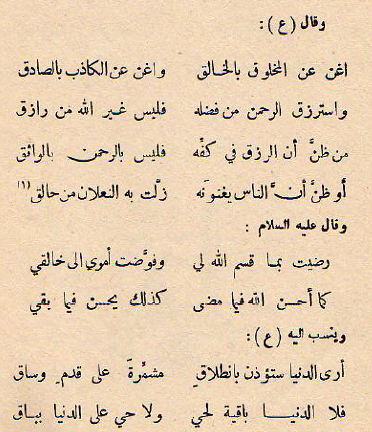
Amirul Mumineen (AS) says:
1. Trust the Creator rather than his creation, trust the Truthful rather than the lier.
2. Seek Rizq from al-Rahman (Allah), as there is no one else who can feed you except Him.
3. He who thinks that his rizq or earnings is in his own hands does not trust Allah.
4. He who thinks that a mere human can feed him or provide a living to him has gone on a slippery way and is sure to fall.
Amirul Mumineen (AS) further says:
1. I am happy with whatever Allah has parted for me and have submitted by will to by Creator.
2. Just as Allah has done my betterment in the past so will He in the future.
These words are said to to those of Amirul Mumineen (AS):
1. I anticipate that the world will soon be over and has prepared for its journey.
2. Never has the world been forever for anyone, nor has anyone stayed in the world forever.
1. Trust the Creator rather than his creation, trust the Truthful rather than the lier.
2. Seek Rizq from al-Rahman (Allah), as there is no one else who can feed you except Him.
3. He who thinks that his rizq or earnings is in his own hands does not trust Allah.
4. He who thinks that a mere human can feed him or provide a living to him has gone on a slippery way and is sure to fall.
Amirul Mumineen (AS) further says:
1. I am happy with whatever Allah has parted for me and have submitted by will to by Creator.
2. Just as Allah has done my betterment in the past so will He in the future.
These words are said to to those of Amirul Mumineen (AS):
1. I anticipate that the world will soon be over and has prepared for its journey.
2. Never has the world been forever for anyone, nor has anyone stayed in the world forever.
Saturday, May 09, 2009
Smart Saving Tips
Save 10% every day!
It’s a basic idea. If you remember to reduce ten percent on the quantity of things you use everyday, you’ll find you are spending less every day. And this will show in your bills, your grocery bills, and overall in how much you spend every month.
The small quantities add up to save you money.
Imagine, 10% less oil while cooking (good for your heart, anyway), less soaps and detergents, less electricity (turn off the AC, switch off lights, switch on the water heater just for a few hours before shower time)
Simple actions like doing laundry at home when possible may save you money every week as opposed to taking all your clothes into a dry cleaner.
Make less trips using your car, by planning trips ahead of time – and you’ll see major savings at the petrol station. If you have two cars, and one is a big SUV and the other a small run around, use the smaller car that consumes less fuel when possible.
Saving as a habit
You need to make savings a regular habit. Instead of saving whatever is left over at the end of the month, plan on saving – which is paying yourself – first. Set aside the amount you plan to save first before you start spending on everything for the month. Plan on this with your family, and this can be an exciting way to get everyone involved, once you have explained the benefits of saving money.
Making a budget
In order for you to make a regular savings plan and make a habit out of it, it’s best to sit down and prepare a budget – so you know exactly how much you want to spend, on what, and how much you want to save. A pre-planned budget will help you in allocating your spending and controlling on sudden bursts of unintentional spending.
Have a Savings Goal and meet it
"Don't save what is left after spending; Spend what is left after saving" - Warren Buffet
The best way to figure out how much you want to save is to set specific monetary goals. If there is a specific thing that you are saving up for, start by calculating how much you will need to save in order to pay for it. Next, figure out how much money you will have to set aside each month in order to reach that goal in a reasonable amount of time. If you are saving for something with a less specific monetary value (such as money for an emergency fund, your retirement, or just a healthy nest egg), then you should try and come up with a figure to shoot for (i.e. Financial experts often recommend having enough money in an emergency fund to cover at least 3 to 6 months worth of household expenses).
Take advantage of the downturn?
Yes, you can. There are a lot of retail outlets and shops that have reacted to the downturn in the economy by offering special sales incentives. You can get discounts on many every day items and as well on some electronics and white goods (washer/dryers, fridges, ovens etc). If you have an immediate need for any of these items, this would be a good time to purchase them – while they are on discounted sale.
Simple economics: every day, every week, every month.
Eating out and treating yourself is fun, and once in a while, it’s a good idea. But a quick and easy way to curb your spending – and start saving – is eating out less. Try eating in more often and packing yourself a lunch for eating at work. Besides saving money, making your own food can often be healthier too. You can save a lot by eliminating that expensive coffee latte habit. You can save on unnecessary and unused magazine subscriptions, tv channels you pay for but don’t watch, phone related expenses. These are every day things you can either curb or totally cut down on. And yes, they add up to your savings.
Interesting Videos: Money Spent is Money Earned http://www.fakhriprofessionals.com/new/debate1/debate1.html
It’s a basic idea. If you remember to reduce ten percent on the quantity of things you use everyday, you’ll find you are spending less every day. And this will show in your bills, your grocery bills, and overall in how much you spend every month.
The small quantities add up to save you money.
Imagine, 10% less oil while cooking (good for your heart, anyway), less soaps and detergents, less electricity (turn off the AC, switch off lights, switch on the water heater just for a few hours before shower time)
Simple actions like doing laundry at home when possible may save you money every week as opposed to taking all your clothes into a dry cleaner.
Make less trips using your car, by planning trips ahead of time – and you’ll see major savings at the petrol station. If you have two cars, and one is a big SUV and the other a small run around, use the smaller car that consumes less fuel when possible.
Saving as a habit
You need to make savings a regular habit. Instead of saving whatever is left over at the end of the month, plan on saving – which is paying yourself – first. Set aside the amount you plan to save first before you start spending on everything for the month. Plan on this with your family, and this can be an exciting way to get everyone involved, once you have explained the benefits of saving money.
Making a budget
In order for you to make a regular savings plan and make a habit out of it, it’s best to sit down and prepare a budget – so you know exactly how much you want to spend, on what, and how much you want to save. A pre-planned budget will help you in allocating your spending and controlling on sudden bursts of unintentional spending.
Have a Savings Goal and meet it
"Don't save what is left after spending; Spend what is left after saving" - Warren Buffet
The best way to figure out how much you want to save is to set specific monetary goals. If there is a specific thing that you are saving up for, start by calculating how much you will need to save in order to pay for it. Next, figure out how much money you will have to set aside each month in order to reach that goal in a reasonable amount of time. If you are saving for something with a less specific monetary value (such as money for an emergency fund, your retirement, or just a healthy nest egg), then you should try and come up with a figure to shoot for (i.e. Financial experts often recommend having enough money in an emergency fund to cover at least 3 to 6 months worth of household expenses).
Take advantage of the downturn?
Yes, you can. There are a lot of retail outlets and shops that have reacted to the downturn in the economy by offering special sales incentives. You can get discounts on many every day items and as well on some electronics and white goods (washer/dryers, fridges, ovens etc). If you have an immediate need for any of these items, this would be a good time to purchase them – while they are on discounted sale.
Simple economics: every day, every week, every month.
Eating out and treating yourself is fun, and once in a while, it’s a good idea. But a quick and easy way to curb your spending – and start saving – is eating out less. Try eating in more often and packing yourself a lunch for eating at work. Besides saving money, making your own food can often be healthier too. You can save a lot by eliminating that expensive coffee latte habit. You can save on unnecessary and unused magazine subscriptions, tv channels you pay for but don’t watch, phone related expenses. These are every day things you can either curb or totally cut down on. And yes, they add up to your savings.
Interesting Videos: Money Spent is Money Earned http://www.fakhriprofessionals.com/new/debate1/debate1.html
Tuesday, April 14, 2009
Subscribe to:
Posts (Atom)